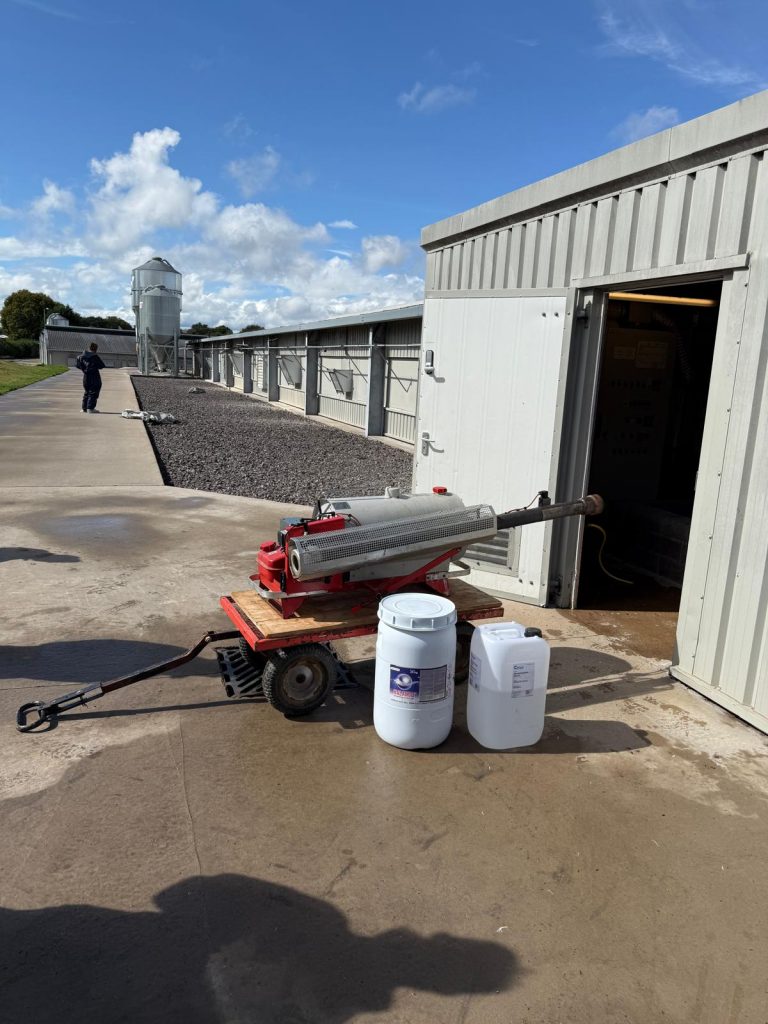
Cleaning and disinfecting poultry houses is no longer a case of “the more product, the better.” Instead, the focus has shifted to tailored biosecurity and cleaning programmes designed for each individual shed or house. One increasingly important component of these customized strategies is the use of thermal fogging with the right product.
Poultry diseases have wide-ranging consequences, affecting everything from animal welfare to the costs of culling and flock replacement. Highly pathogenic avian influenza (HPAI) continues to spread across many regions of the world, while bacterial threats such as Salmonella, E. coli, Enterobacteria, and Campylobacter remain persistent challenges. Complicating matters further, disease is not always visible, especially in its early stages, and can enter and spread through multiple pathways. This makes prevention critical. Robust biosecurity measures, including thorough cleaning and disinfection, are essential to keeping viruses and bacteria out of poultry farms.
Know the pathogen load before disinfection
Over the years, cleaning methodologies have not only become more widely recognised and applied, but also more precise and targeted. Dave Oram, Field Services Technician at St David’s Poultry Team, an independent veterinary practice in the UK and Ireland, explains: “When our veterinarians detect issues on a farm, such as changes in feed intake, feed efficiency, or mortality rates, we begin testing to identify the pathogen and assess the viral load. Based on those results, we then select the most appropriate products for cleaning.”
Dave notes that this focused, data-driven approach was not always the norm. “In the past, we often used disinfectants at levels higher than necessary, essentially applying the maximum rates across the entire farm. But it’s no longer a case of ‘more is better.’ Today, we have a deeper understanding of pathogen loads and epidemiology, along with improved measurement tools. This allows us to choose the right strategy and use correct amounts of product, making the process far more cost-effective.”
Forcing the disinfect to reach every crack
Before disinfection can begin, dust, organic matter, residue and biofilm, must be thoroughly removed from feeders, drinkers, and all other surfaces. This is done by washing. Detergent is then applied. After the recommended dwell time, the detergent is washed off. After this secondary washing, a visual assessment is made to determine that a thorough clean has been carried out and there is no visual traces of organic matter remaining. Dave explains: “As the final step of the protocol, we apply thermal fogging. We do this once all equipment and bedding have been returned to the barn. Thermal fogging produces ultra-fine droplets (between 1 and 50 μm) that create dense, visible fog clouds when released into the barn air. It is not the same as cold fogging or misting. Thermal fogging relies on heat to keep the fog suspended in the air. The great advantage is that it drives the disinfectant into every crack in the walls, and even into areas through and under the roof.”
Proper preparation of the sheds is essential when using thermal fogging. Dave advises: “Measure your shed and calculate the amount of fogging solution required. Check that the water is clean before mixing the solution and ensure all mixing equipment is clean. Prepare your products, wear full PPE and a mask when mixing, close all ventilation and turn off all the fans. The mixed solution is then poured into the reservoir of the thermal fogging machine, and the process can begin. Always have hot water available. After thermal fogging is completed, the birds are placed in the shed the following day. After 6 to 7 days, we test the pathogen load again to confirm the cleaning and disinfection protocol worked effectively.”
Choosing a disinfect that is safe and effective
The cleaning and disinfection protocol, and the choice of products, can make or break a farm’s biosecurity strategy. St David’s Poultry Team, along with many farms worldwide, has chosen Halamid® for disinfecting poultry operations. Developed by Axcentive, Halamid® is a versatile, readily biodegradable biocide that is safe for humans, animals, and the environment. Its popularity continues to rise, especially as the use of formaldehyde becomes increasingly restricted in the EU and UK. Halamid® is even safe enough to apply over feed during thermal fogging, an advantage when starter feed has already been placed on paper in the sheds before a new batch of chicks arrives. As Oram explains: “I don’t know of another product that has been successfully used over feed. After trying this, we saw no loss of appetite in the chicks.”
Halamid® effectively eliminates a wide range of pathogens which includes: Salmonella, Avian Influenza, Campylobacter, Newcastle Disease, and Gumboro, at a concentration of 0.5% (1:200) or thermal fogging with a 10% concentration, in accordance with European standards. Its unique formulation supports a wide range of uses, such as terminal disinfection by wet spraying, misting, or thermal fogging; aerial disinfection; water system sanitation; wheel and foot dips; and vehicle or egg disinfection. Dave notes that thermal fogging with Halamid® enhances the overall efficacy of the cleaning protocol by adding a secondary stage of disinfection. It also saves significant time: thermal fogging can be completed the night before chick placement, with only ventilation needed the following morning.
Thermofogging demo held during the Halamid® Conference in September 2025: